Divination isn’t about predicting the future — it’s about learning how you already listen for guidance. So what counts as divination, and are you using it without realising?
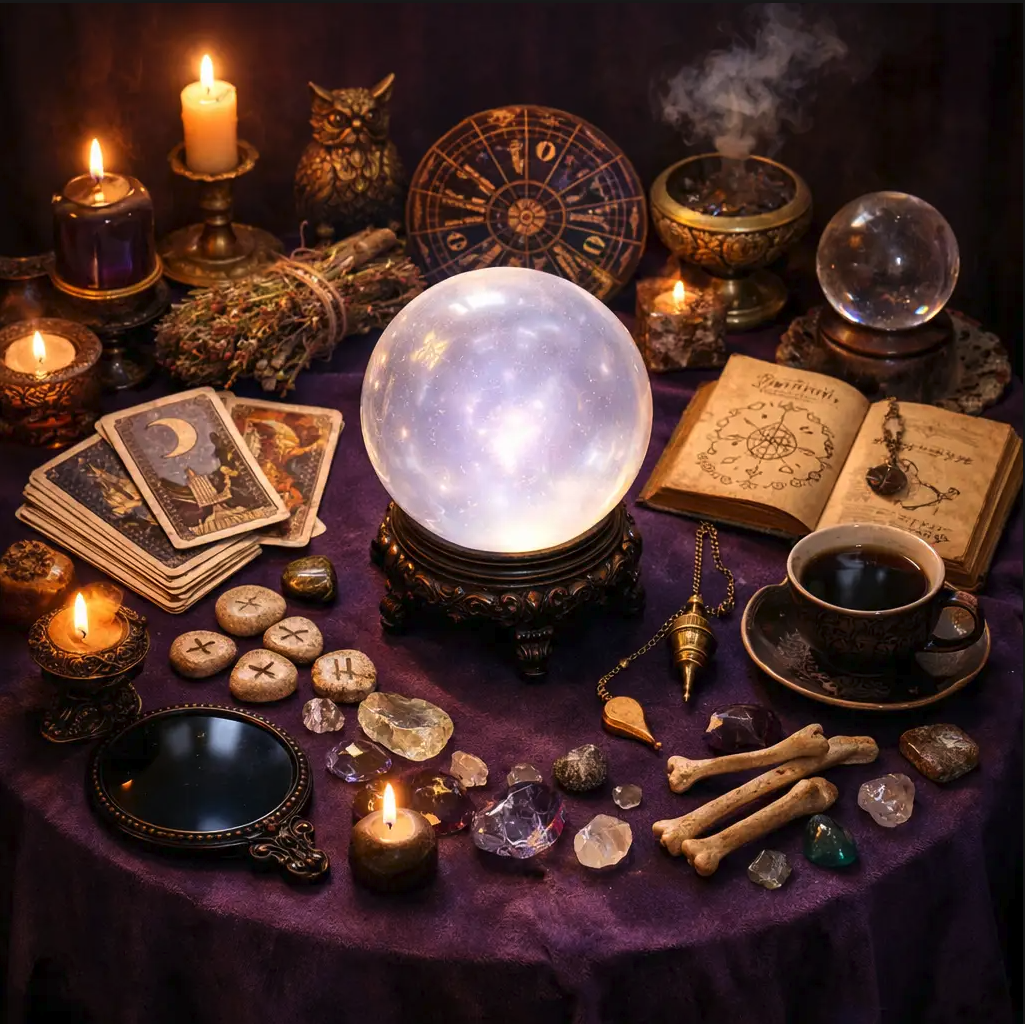
Divination can take many forms, from tarot and runes to pendulum work, scrying, and intuitive tools. This a symbolic overview of common divination tools, including tarot, runes, pendulums, and crystal gazing.
Divination is one of the oldest spiritual practices in human history. Across cultures and centuries, people have turned to divination for guidance, insight, and meaning, using symbolic tools and intuitive practices to better understand themselves and the world around them. From ancient temples and hearth fires to modern spiritual spaces, divination has always been a way of listening more deeply — to intuition, to cycles, and to unseen currents of wisdom.
Today, divination is less about predicting fixed outcomes and more about reflection, awareness, and spiritual connection. Many people are drawn to divination tools not because they want absolute answers, but because they are seeking clarity, reassurance, or a different perspective during moments of change. Tarot cards, runes, pendulums, astrology, and scrying practices each offer their own language for insight, inviting us to pause, ask meaningful questions, and notice what arises within us.
If you’re new to divination, the variety of practices can feel both fascinating and overwhelming. This guide explores the
main types of divination, explaining how different divination tools are used, what they are traditionally associated with, and how they can support intuitive and spiritual development. Whether you are simply curious or beginning to explore your own intuitive abilities, understanding the types of divination available can help you find the practices that resonate most with you.
SCRYING (Mirror, Water, Crystal & Fire)
Scrying is an ancient divination method that involves gazing into a reflective or shifting surface to receive images, symbols, or intuitive impressions. Traditional tools include mirrors, bowls of water, crystal balls, polished stones, and fire or candle flame. Rather than seeing the future, scrying is commonly understood as a way to access the subconscious, deepen intuition, and receive symbolic guidance.
Historically, scrying appears across multiple cultures and time periods, often used by mystics and seers for spiritual insight. In modern practice, it is typically approached as a meditative, trance-like technique: softening the gaze, quieting the mind, and interpreting any shapes, scenes, colours, or sensations that arise. Many practitioners pair scrying with grounding and protection, setting a clear intention and closing the practice afterwards.
TAROT DIVINATION
Tarot cards originated in 15th-century Italy, where they were first known as Carte da Trionfi (Cards of Triumph). Early Tarot decks appeared in Venice, Milan, Florence, and Urbino, and were initially used as a card game rather than for spiritual readings.
By the 16th century, the Tarot deck became standardised into 78 cards, divided into the Major Arcana, representing life lessons and spiritual themes, and the Minor Arcana, made up of four suits with court cards. In the late 18th century, Tarot began to be used for divination, particularly through the work of Jean-Baptiste Alliette (Etteilla).
The most recognisable modern Tarot deck, the Rider–Waite–Smith, was created in 1909 by Arthur Edward Waite and artist Pamela Colman Smith. Today, Tarot is widely used as a tool for intuition, reflection, and personal growth.
PENDULUM DIVINATION
Pendulum divination has roots in Ancient Egypt and China, dating back to around 2000 BCE. Pendulums were believed to help locate hidden water, objects, and energetic imbalances. Over time, they became a method for seeking answers to personal and spiritual questions.
By the 17th century, pendulums were commonly used for intuitive guidance. In the 19th and early 20th centuries, spiritualists viewed pendulums as a communication tool between the physical and spiritual worlds.
In 1833, scientist Michel Eugène Chevreul proposed that pendulum movement was influenced by involuntary subconscious muscle responses, now known as the ideomotor effect. Today, pendulums are commonly used as an intuitive aid rather than an external authority.
TASSEOMANCY (Tea Leaf Reading)
Tasseomancy, or tea leaf reading, developed primarily in Europe, particularly in Wales, Ireland, Scotland, and England. While tea drinking originated in China around 1500 BCE, tea leaf reading became popular after tea was introduced to Europe in the 17th century.
Loose tea leaves were brewed without strainers, leaving sediment in the cup. The patterns formed by the leaves were interpreted symbolically, often by working-class practitioners reading for wealthier clients. During the 19th century, Britain became strongly associated with this form of divination.
Today, tasseomancy is viewed as a reflective and symbolic practice rooted in folklore and intuition.
TOTEMS & ANIMAL GUIDES
Totems and animal guides appear in spiritual traditions worldwide, particularly in African and Indigenous cultures. A totem is often understood as an animal or object that acts as a guardian or protector for an individual, family, or community.
The term totem originates from the Ojibwe language, meaning “his totem.” In many traditions, ancestors are believed to return as animals or natural symbols to continue guiding the living.
In Ancient Egypt, animals were seen as living embodiments of divine energy. Deities such as Horus (falcon) and Bastet (cat) represented protection, kingship, fertility, and home. Today, animal guides are commonly used as tools for insight and spiritual connection.
PALMISTRY (Chiromancy)
Palmistry, also known as chiromancy, is believed to have originated in ancient Hindu astrology and early Romani traditions. Written references date back around 7,000 years, attributed to the sage Valmiki.
Palmistry is considered a branch of Samudrika Shastra, the study of physical markings to understand character and life themes. The practice spread to Ancient Greece, where figures such as Aristotle and Alexander the Great reportedly used palm reading.
During the Renaissance, palmistry was suppressed by the Church as one of the forbidden arts, but interest revived in the 19th century through practitioners such as Cheiro. Today, palmistry is used as a reflective tool rather than a fixed predictor of fate.
RUNE CASTING
Rune casting originates from Norse and Germanic traditions. The word rune is believed to mean “secret” or “whisper,” reflecting hidden knowledge. The earliest runic system, the Elder Futhark, dates to the 2nd century CE and contains 24 symbols.
This later evolved into the Younger Futhark and the Anglo-Saxon Futhorc. Traditionally, runes were carved into wood or stone and cast onto cloth for interpretation.
According to Norse mythology, the god Odin gained knowledge of the runes through sacrifice on the World Tree, Yggdrasil, and shared their wisdom with humanity. In the modern era, rune casting was popularised by Ralph Blum.
DIVINATION IN THE MODERN WORLD
Today, divination is widely understood as a tool for reflection, intuition, and self-awareness rather than prediction. Ethical practice emphasises grounding, consent, and personal responsibility, empowering individuals to connect with their own inner wisdom.