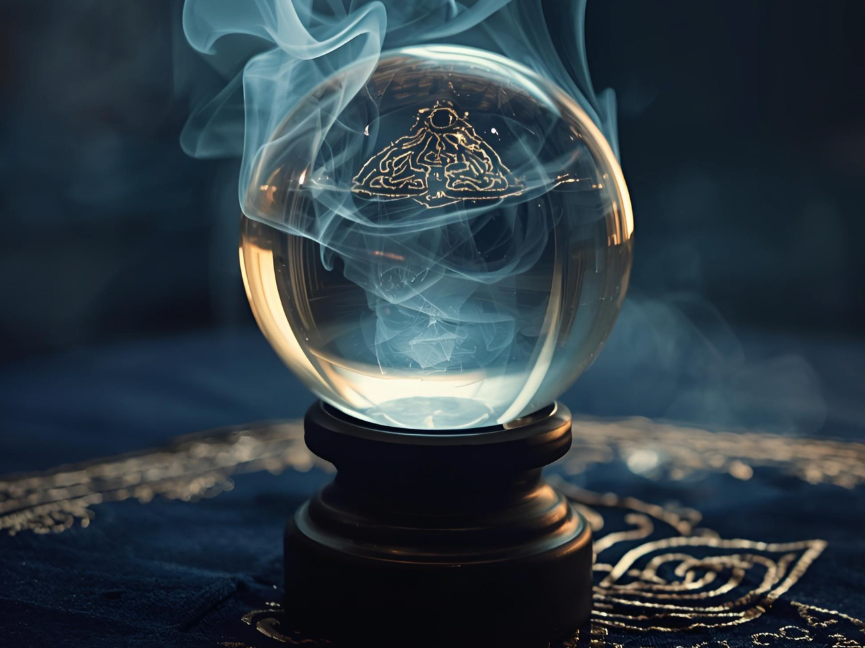
A crystal ball representing ancient divination practices and the human search for meaning, guidance, and understanding.
Divination is one of the oldest spiritual practices humanity has ever known, and yet it remains one of the most misunderstood. For some, the word brings curiosity and intrigue. For others, discomfort, scepticism, or fear. Often, both at the same time. In modern culture, divination is frequently reduced to prediction — a way of finding out what will happen, who will return, or how something will end. But this framing is recent, and it misses the deeper truth of the practice entirely.
Divination did not begin as fortune-telling. It began as listening. To understand divination properly — especially as a beginner, we need to step away from fear, spectacle, and certainty, and return to what divination has always been: a way of engaging with symbols, cycles, and meaning in order to better understand the present moment.
The Meaning of Divination
At its simplest, divination is the practice of seeking insight through symbolic systems. The word itself comes from the Latin divinare, meaning “to foresee” or “to be inspired,” but historically this inspiration was not about controlling the future. It was about recognising patterns, timing, and relationship — between people, nature, and the unseen. Across cultures and centuries, divination has taken many forms. Tarot cards, oracle cards, runes, pendulums, astrology, scrying, and the I Ching are all examples of divination tools. While they differ in method, they share a common purpose: to provide context, not certainty. Divination was never meant to replace human judgement. It existed alongside it.
Divination as a Human Practice, Not a Mystical Shortcut
One of the most important things for beginners to understand is that divination is not a shortcut to answers. It does not bypass lived experience, emotional work, or personal responsibility. Historically, divination was embedded in daily life. It was used to mark seasons, understand transitions, prepare for change, and reflect on collective decisions. It was slow, contextual, and deeply connected to the rhythms of nature and community. Modern divination often happens in isolation, under pressure, or in moments of emotional urgency. This can distort the practice, making it feel heavier than it needs to be. When divination is approached gently, it becomes a way of orienting yourself — not a test you must pass or a future you must obey.
How Divination Tools Actually Work
Divination tools do not contain answers in themselves. Tarot cards do not “know” anything. Pendulums do not decide. Runes do not predict events. These tools act as interfaces — ways of bringing subconscious awareness, intuition, and symbolic thinking into conscious focus. When you pull a tarot card or cast a rune, you are engaging with a system of meaning that helps you see something differently. The insight comes not from the object, but from the interaction between symbol, question, and awareness. This is why the same tarot card can mean different things in different readings. Context matters. Timing matters. The person asking the question matters. Divination is not about being told. It is about noticing.
Common Divination Tools Beginners Encounter
Most beginners encounter divination through tarot cards. Tarot has become one of the most accessible and widely searched divination tools, with people often asking “what is a tarot reading?” or “how does tarot work?” Tarot uses a structured deck of symbolic imagery to explore themes such as choice, change, conflict, growth, and rest. Contrary to popular belief, tarot cards do not predict specific events. They reflect emotional dynamics, patterns, and possibilities. Oracle cards function similarly, though they are less structured and vary widely in theme and symbolism. Runes, one of the oldest divination systems, use carved symbols drawn from ancient alphabets, offering insight through simplicity and depth. Pendulum divination works through subtle bodily response rather than external symbolism, often raising important questions about self-trust and nervous system regulation. Astrology, while often treated separately, is also a form of divination — one that interprets cycles and timing rather than fate. Each tool speaks a different symbolic language, but none of them remove personal agency.
Divination for Beginners: What It Is Not
For those new to divination, it’s important to gently dispel some myths. Divination is not about predicting death, disasters, or unavoidable outcomes. It is not about being chosen, gifted, or special. It does not require psychic ability, and it does not override logic, therapy, or common sense. Divination should never induce fear. If it does, something in the approach needs adjusting. A beginner’s relationship with divination should feel curious, spacious, and grounding. If it feels urgent, compulsive, or overwhelming, it’s worth pausing. Divination is a practice — not a performance.
The Role of the Question
One of the most overlooked aspects of divination is the quality of the question being asked.
Beginners often ask questions that seek certainty:
“What will happen?”
“Will this work out?”
“Is this my destiny?”
These questions are understandable, but they place divination in a position of authority it was never meant to hold.
Divination responds best to reflective questions:
What is influencing this situation?
What am I not seeing clearly?
What is being asked of me right now?
What supports or challenges this path?
These questions invite insight without surrendering choice.
Divination, Free Will, and Ethics
A common concern for beginners is whether divination interferes with free will. In truth, ethical divination depends on free will. Divination does not remove choice — it highlights it. When divination is used ethically, it reinforces autonomy. It encourages discernment rather than dependence. It does not tell someone what to do, but helps them understand what they are responding to. This is especially important in a world where many people feel disconnected from their own intuition. Divination can help rebuild that connection, but only if it does not replace it.
Divination and the Nervous System
Divination is often approached as a purely spiritual practice, but it is deeply embodied. If someone is anxious, dysregulated, or emotionally overwhelmed, the symbols they encounter may be filtered through fear. This can lead to misinterpretation, projection, or over-attachment to outcomes. For beginners, grounding matters more than technique. A calm body allows clearer interpretation. A regulated nervous system allows discernment. Divination practiced without grounding can feel confusing or unsettling, not because it is wrong, but because the body does not feel safe enough to receive it. Divination should meet the body where it is, not override it.
Learning Divination Slowly
In a culture that values speed and certainty, it can be tempting to rush divination. To memorise meanings, seek confirmation, or rely on external interpretations. But divination is learned slowly. It deepens through relationship, not mastery. Beginners benefit most from:
• Consistent, gentle practice
• Reflective journalling
• Noticing patterns over time
• Allowing meanings to evolve
Divination is not about getting it right. It is about becoming more attentive.
Why Divination Still Matters Today
In uncertain times, it makes sense that people turn toward spiritual tools. Divination offers language when life feels unclear. It provides symbolism when logic alone is insufficient. But its value lies not in prediction, but in perspective. Divination helps people slow down, reflect, and reconnect with themselves. It creates space between impulse and action. It offers insight without instruction. When practiced ethically, divination supports resilience rather than dependency.
Beginning Without Needing to Know
Perhaps the most important thing a beginner can understand is this: you do not need to believe in divination to begin engaging with it meaningfully. You only need curiosity, honesty, and willingness to listen. Divination does not ask you to surrender your thinking, your autonomy, or your responsibility. It asks you to pay attention — to patterns, symbols, timing, and yourself. And perhaps the real question is not “What is divination?” but: What happens when I stop looking for answers and start noticing meaning? How might symbols help me listen differently to my own life? What would it feel like to trust insight without giving up choice? Divination has always been less about knowing the future, and more about being present enough to meet it.