How to Read Without Giving Your Power Away
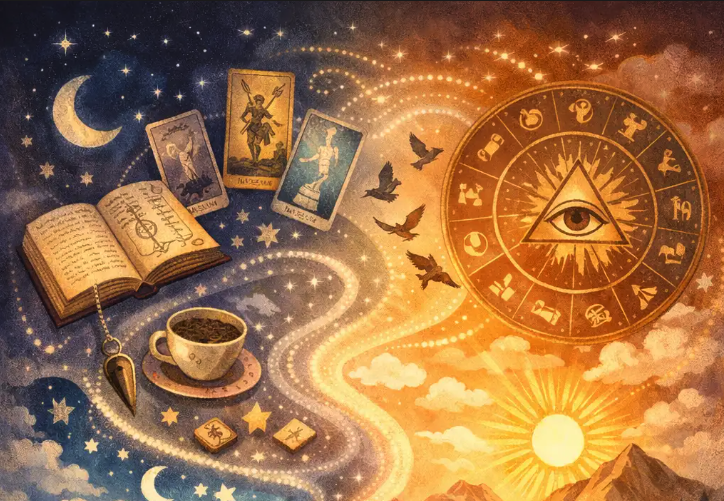
A symbolic illustration of divination tools including a crystal ball, runes, candles, and a winding path representing intuition, spiritual insight, and inner guidance
Divination, a spiritual practice often misunderstood in modern culture, is frequently framed as prediction – a means to glimpse the future, validate fears or find certainty in uncertainty. This misconception fuels anxiety surrounding tarot readings oracle cards and pendulums. However, divination wasn’t ever intended to be merely a crystal ball. At its core, it’s a language between you and the spirit, conveyed through these symbolic, intuitive and responsive tools. When viewed as prediction, divination strips away agency. Conversely, understanding it as language restores it. This distinction transcends philosophy; it’s ethical, practical and profoundly important for anyone engaging in divination, whether a beginner, reader or regular reader of readings and other divination tools. Throughout history, divination has manifested in various forms of the centuries, and those forms have stayed pretty consistent:
• Tarot and oracle cards
• Runes
• Pendulums
• Astrology
• Scrying
• The I Ching
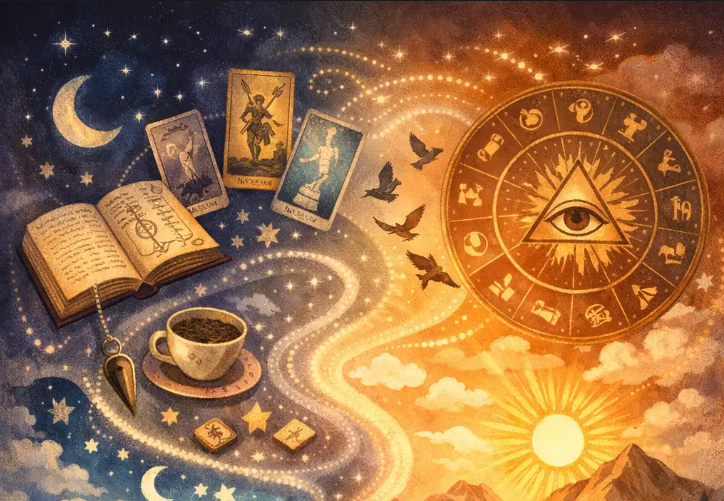
An illustration of divination tools including tarot cards, astrology symbols, a pendulum, and a zodiac wheel, representing intuition, spiritual insight, and symbolic guidance
Despite the various tools used, the core purpose remains the same: interpreting symbols, patterns and timing in relation to the present moment. Divination operates through symbolic meaning rather than literal outcomes. For instance, tarot cards don’t contain specific events but rather archetypes, themes, dynamics and invitations for reflection. A tarot reading doesn’t predict the future; it describes what’s currently happening, influencing factors and potential outcomes if nothing changes. This is quite different from prediction-based divination. This can cause anxiety, especially for those already feeling anxious uncertain or overly hopeful. They seek answers and responses to free themselves or escape undesirable situations. The truth is, no divination is truly predictable unless the predicted answer aligns with their intended outcome. If they don’t receive the expected answer, it can inadvertently heighten their anxiety.
This removes free will and when free will is gone the nervous system goes into threat mode. It’s no surprise then that searches like “is divination dangerous”, “bad tarot reading experience” and “divination anxiety” are so popular. The problem isn’t divination itself but how it’s used and communicated. Ethical divination should reduce fear not amplify it. When we say divination is a language we mean it quite literally. Like any language it has a vocabulary (symbols suits archetypes) grammar (how cards interact positions timing) context (the question the person the moment) and tone (emotional state readiness clarity). As the reader learns this unique language created by them and spirit the connection grows stronger. The tool acts as confirmation for both sitter and reader but it’s the subtle conversation happening behind the tool.

A symbolic illustration of divination tools including a crystal ball, runes, candles, and a winding path representing intuition, spiritual insight, and inner guidance.
A tarot card’s meaning varies depending on the context of the reading. This includes the reader’s observations, experiences and the specific question posed. The position of the cards – upright, crossed or reversed – also matters. For example, The Tower can signify collapse, liberation, truth or release. However, its meaning differs between a love reading and a home reading. Similarly, The Fool can represent beginnings, naivety, trust or avoidance. Does this resonate with the sitter or someone they know? Pentacles can relate to money, health, the body, work or long-term stability. For instance, the Queen of Pentacles might mean care, abundance and security in a love reading, but differently in the reversed position. Intuition is often considered the best way to interpret tarot, contrasting with rigid meanings. These interpretations can sometimes fail the sitter. For example, seeing the Queen of Pentacles in a torsional reading might suggest care, abundance and security, money and stability. This is quite general and could apply to anyone. Divination requires discernment, observation and listening to subtle messages from spirit, rather than mere memorisation.
Tarot encourages curiosity.
The way you ask questions matters, not just with Tarot but all divination. For example, asking when you’ll meet your soulmate is difficult because so many factors influence the outcome. Think of the movie Sliding Doors – so much of our free will affects the choices we make. I might choose a planned walk with my dogs, where I’ll meet the person I’ve been hoping to see. Then my phone rings, and I answer it, delaying the walk by just 10 minutes. Busy with the call, I take a shortcut, getting stuck in temporary traffic lights and missing my planned walk by at least seven minutes. Seventeen minutes is a long time, and when I pull into the car park, the person I was waiting for drives out.
A good Tarot reading asks: What’s happening right now? What’s preventing the desired outcome? What do I need to do to prepare? What do I need to know before it can happen? These are the questions Tarot loves to answer. When and how questions open up to unforeseen possibilities and free will.
Tarot reading becomes unsafe when it overrides personal agency. Ethical readers understand that timing shifts, choices matter, and nothing is fixed. This is especially important for beginners learning divination, who often fear making mistakes. You can’t get a language wrong; you can only be learning to listen. As Divination without free will becomes control.
Every ethical divination practice should centre these truths:
• The future is not fixed
• Insight does not equal instruction
• A reading is not authority
• The client (or reader) always retains choice
Divination honours free will and becomes empowering, but when it disregards it, it fosters dependency. This explains why repeated readings on the same question often lead to confusion. The language becomes distorted because the person is no longer truly listening; they’re seeking reassurance.
Divination occurs through a human body, so it doesn’t happen in a vacuum. If someone is dysregulated, anxious or traumatised, the symbols they receive can be filtered through fear. This doesn’t mean divination is wrong; it simply highlights the importance of the state. Before any divination practice, grounding is essential. This isn’t about feeling “calm” but finding safety within the body.
A regulated nervous system enables clearer interpretation, less projection, better discernment and reduced anxiety after readings. This is why ethical divination involves preparation, not just tools.
Divination Tools Are Not the Power
Another common misconception is that the power lies in the tool. Tarot cards, oracle decks, pendulums and generators are interfaces, not sources. A random tarot card generator online can prompt insight, but it can’t replace embodied awareness or discernment.
The danger isn’t tools; it’s outsourcing intuition. Divination should deepen self-trust, not replace it.
Reading for Yourself: A Special Case
Many people ask, “Can you do divination for yourself?” Yes, but it requires honesty.
Self-reading becomes difficult when you’re emotionally activated, seeking certainty rather than insight, asking the same question repeatedly or ignoring answers you don’t like. This is where divination as language is vital. You’re not asking for a verdict; you’re entering a dialogue.
Sometimes the answer is clarity, sometimes it’s “not yet” and sometimes it’s silence. All are valid.
Divination for Beginners: Where to Start
If you’re new to divination, begin with these principles: learn symbols, not scripts.
• Ask reflective questions
• Focus on the present moment
• Notice patterns, not outcomes
• Stop when anxiety rises
Beginner divination thrives on a slow, embodied and curious approach. You’re not predicting; you’re learning a language.
Why this reframing matters now:
In a world of uncertainty, people crave certainty. This explains the popularity of keywords like tarot meaning, free tarot, yes or no tarot and random tarot card. However, divination doesn’t offer certainty; it offers relationships with yourself, timing and inner knowing.
When we return divination to its rightful place as a language, it becomes:
• Ethical
• Empowering
• Grounded
• Supportive rather than addictive
Final thoughts: Listening, not Foretelling
Divination isn’t about predicting the future. It’s about helping you listen:
• to yourself
• to your patterns
• to the present moment
• to what needs change
Approached this way, divination becomes a tool for growth, reflection and agency – not fear, dependency or prediction. It’s not a prophecy; it’s a conversation. And like all meaningful conversations, it requires presence, honesty and choice.