Many people come to divination hoping for reassurance — and fearing what they might hear. But what if divination was never about good or bad outcomes at all?
Divination Without Fear: Moving Beyond
“Good or Bad” Outcomes

An illustration symbolising mediumship, showing a messenger delivering a letter while spirit figures appear in the background, representing spiritual communication and intuitive message delivery.
My first encounter with tarot came in my late thirties. I hadn’t grown up with cards, nor had I been trained in a specific lineage or followed the “rules” many insist are essential. Instead, I experienced a natural awakening of my mediumship, sparking a curiosity about tools to understand spirit’s communication. My first deck was the Vice Versa Tarot. I didn’t buy it because someone recommended it or it was gifted. I bought it because I liked its appearance and felt drawn to it. That was all the reason I needed.
At the time, many people advised against buying your own tarot deck, claiming it was unlucky or wouldn’t work properly. I never subscribed to this belief. In fact, that deck has been incredibly helpful over the years. It taught me early on that superstition and fear have no place in divination; trust does. When I first started, I didn’t even know how to shuffle. I kept the cards in a soft velvet bag, reached in, rummaged around, and pulled out whatever came to hand. There was no technique, ceremony, or confidence; just curiosity and willingness. Over time, I learned to shuffle, let cards fall or flip when needed, and stop forcing the process. I invited spirit to work with me, almost as if placing their hands over mine, guiding which cards were chosen. Then, one day, spirit revealed something transformative. They showed me the image of a postman delivering an envelope, knocking on a door, handing it over, and walking away.
Initially, I didn’t understand the significance. However, the message was clear: this is how you work. You deliver what comes through without deciding its meaning or worrying about its interpretation. It will be received. You don’t judge whether the message is good or bad; you simply deliver it.
That moment reshaped my entire relationship with divination. I realised my role wasn’t to analyse, soften or control the message but to listen—through my thoughts, body and senses—and pass on what was given. The message’s meaning wasn’t my responsibility, nor was whether the sitter liked, understood or recognised it immediately.
Spirit was very clear: trust spirit beyond the capacity of the human sitting in front of you. That may sound harsh, but it isn’t. Humans forget, memory is imperfect and emotion colours perception. People often come into readings seeking something specific and when they don’t hear it their understanding can narrow. Spirit asked me not to let that sway me.
That didn’t mean becoming cold or detached; compassion and care are essential. However, compassion doesn’t mean editing truth to make it easier to hear. Learning this required a great deal of trust—not only in spirit but in my own protection and boundaries. I had to be certain I was working with my guides and loved ones in spirit and nothing else. That trust took time to build and protection became a non-negotiable part of my practice. As that trust deepened, something else happened. I stopped worrying about outcomes. I realised nothing truly negative ever came through; only messages that could be shaped into something meaningful, supportive and ultimately in the sitter’s highest good, whether they recognised it in that moment or not. Early on, I used to say to people: you don’t get what you want from spirit, you get what you need. And that remains true. Letting go of expectation is essential in divination; the outcome isn’t the point, the message is.
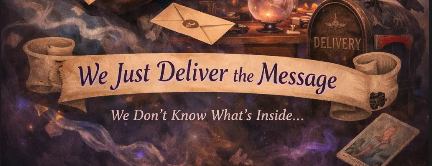
Text reading “We just deliver the message. We don’t know what’s inside,” symbolising the role of a medium as a messenger rather than an interpreter.
This is where the postman analogy really settled in. A postman doesn’t knock on your door and ask if you’re ready for the letter; they don’t open it. An envelope and explain it to you. They don’t decide whether the contents are good or bad news. That would be intrusive and inappropriate. They simply deliver the message and move on. As readers, mediums and diviners, we’re no different. When we start asking “Does that sit with you?” or “Can you take that?” too often, we’re really asking for reassurance, validation, ego-stroking and confirmation that we’re doing it right. But if you truly trust spirit, you don’t need that. The only time I’ll check in is to ensure I’m working with the right energy. I might ask if something relates simply to check my alignment. If not, I’ll move on. If it does, I continue. Beyond that, the message stands as it is.
The interpretation belongs to the sitter, not to me. Spirit works hard to bring messages through and doesn’t need my human brain to twist or reshape them. I don’t need to decide what should be emphasised or softened. My job is to listen deeply and deliver honestly. Sometimes a sitter will say no. That doesn’t mean the message is wrong. Often it means it’s not understood yet. Later, a conversation with a parent, a memory triggered or a moment of reflection might suddenly make it click. So I’ve learned not to be upset by the no’s and not to be excited by the yeses. Neither belong to me. This is what divination without fear looks like.
It’s moving beyond “good” or “bad” outcomes. It’s recognising that outcome-based thinking is ego-led and ego doesn’t belong in a reading. Divination isn’t about performance or prediction; it’s about service, trust and humility.
We’re not here to judge the message. We’re just the messengers. And when we truly understand that, fear dissolves because the outcome was never ours to carry in the first place.