Divination Is a Tool for Awareness
Pendulums, tarot, rune casting, scrying and symbolic systems are designed to develop your awareness. They help you reflect, regulate emotional responses and make grounded decisions. Used ethically, they build intuitive development and personal responsibility.
Ethical divination asks better questions rather than chasing certainty.
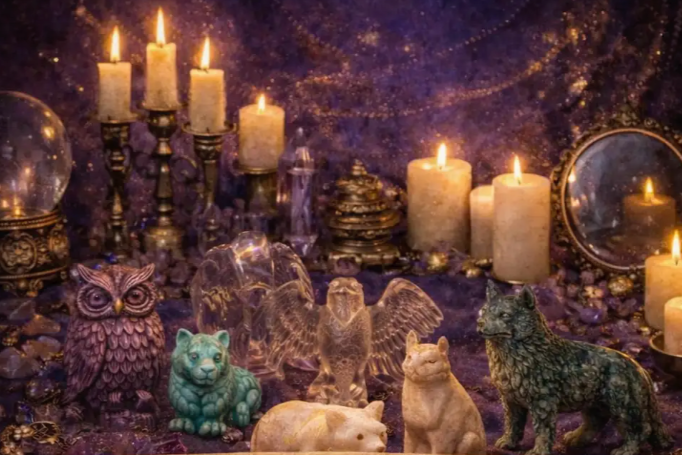
Sacred divination altar with candles, crystal ball and animal spirit symbols illustrating spiritual protection, energetic boundaries and responsible mediumship training.
Boundaries Matter in Spiritual Practice
Divination is a communication tool. The user must have a basic understanding of energetic boundaries before they begin their practice.
Questions such as “Will he come back?” or “What is she thinking?” are not only not helpful in finding out what you really need or want to know, but they also step outside ethical practice. This is something you will see all the time online, and it will give you a clue as to who is trained and genuine over someone who just decided they were going to read tarot or swing a pendulum on a live. We have plenty of blogs on ethical practice over at www.magpie-moon.com, on how to develop and stay within your own ethics.
You cannot simply dip into someone else's energy and ask questions about their path or their energy in general, even when their path is intertwined with ours. Spirit will not respond. A trained practitioner would ask a different question, simply by making it more about the person: “What can I do, if anything, to fix this relationship?” Now the cards can start to reveal the shadow, the childhood wounds, so you can understand where the healing is. If you heal and he still doesn’t come back, then something better and more aligned with you will come along.
From the practitioner's point of view, if they are working untrained, they may be attempting to access someone else’s energy, which creates entanglement. For inexperienced practitioners, this can feel heavy, intrusive or destabilising. It can also open the door to misleading or disruptive spiritual influences.
In a previous article, we explored how divination can be distorted and hijacked when energetic boundaries and a deep connection to your guides are absent. This is not about fear. It is about understanding and learning to lean into the time-honoured techniques, learnings and traditions passed down over hundreds of generations. These rules and ethics have lasted this long for a reason.
Mediumship is a discipline. Spirit communication requires containment, continuous supervision and ethical adjustments, which are normally maintained in a circle that the practitioner attends weekly for practice, development and guidance from their peers.
Instead of “What will happen?”, we ask:
What is unfolding?
What is my role in this?
What needs conscious attention?
What do I need to do in order to achieve this?
That shift alone transforms divination from dependency into development.
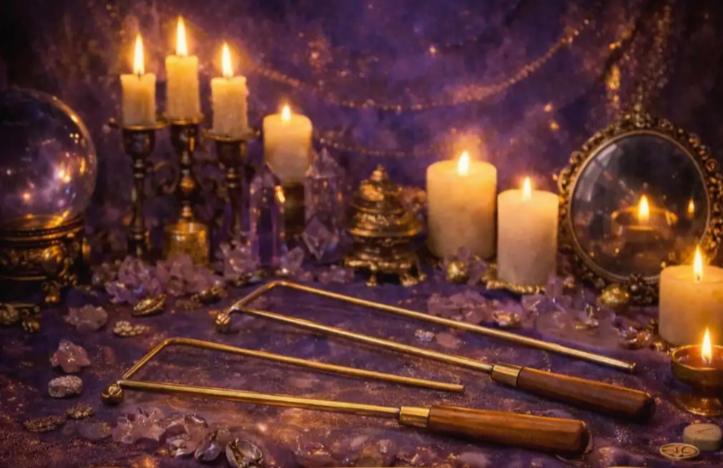
Sacred divination tools including dowsing rods and crystals displayed on an altar, representing ethical spiritual practice, energetic protection and responsible mediumship development.
All of these types of divination share the same ethical practices in common. They only differ in the tool. The energy behind the tool is the same.
They all require grounding and energetic protection. These are practices that are easily forgotten, yet they are the most essential part of working with these tools. Without them, you risk unwanted energies and, in some cases, harmful attachments.
These tools are easy to manipulate — that is why they are easy to use. However, you do not know whether that is your sitter’s nan coming through and moving the pendulum, your guides working with the tarot, or a depleted entity that simply needs your energy.
Scrying requires a quiet mind and an open third eye, meditation and control over the monkey mind. Without discipline, imagination and intuition blur.
Tasseomancy (tea leaf reading) requires reflection and a vast life experience to draw upon, alongside healing work and a deep understanding of the shadow. It is rarely about fixed outcomes.
Cartomancy (tarot and oracle cards) requires symbolic literacy, practice, memory and the ability to see in a fluid way. Cards do not control events. They highlight dynamics and patterns.
Dowsing rods and pendulum work require a huge amount of trust with your guides, a deeper knowing of when they are communicating and when it is something else. It requires practice and presence — noticing the subtle shifts in movement, feeling your guide close within your being and not just in your hands. Calibration and energetic hygiene are essential.
Rune casting requires a deep relationship with your ancestors and a knowing of each symbol. Some rune casters feel such a powerful connection to certain symbols that they commit to having them tattooed onto their bodies.
Palmistry reveals tendencies and temperament. Awareness creates choice.
Totem and animal symbolism are archetypal reflections, drawn down over the centuries and across cultures. Their meanings are strikingly similar in old scripts, long before there were boats and planes connecting civilisations. Animal work for spirit is the only type of divination that does not require protection in the same way — but it does require knowledge of their work here with us.
Across all systems, the principle is the same: awareness over prediction.

Tea leaf reading setup with vintage teacup, candles and crystal ball on a sacred altar, symbolising ethical mediumship, intuitive development and responsible divination practice.
Foundations for Ethical Mediumship and Divination
If you are developing mediumship or intuitive ability, your foundation matters:
Grounding before opening
Clear energetic boundaries
Psychological responsibility
No outsourcing of personal agency
Divination should strengthen discernment, not replace it.
Approached properly, these tools help you:
Develop intuitive clarity safely
Recognise projection and bias
Contain your energy
Reflect before reacting
Respond rather than react
Spiritual growth is structured. It requires practice, supervision and honesty.
Development Over Dependency
At Magpie Moon, we teach structured spiritual development rooted in ethical mediumship, energetic protection and psychological awareness.
Divination is not a shortcut to certainty. It is a discipline that builds perception and personal sovereignty.
If you are serious about responsible divination practice, intuitive development and mediumship training, choose structure over impulse.
Development over dependency.
Awareness over prediction.
Practice over performance.
Explore our training and the Spiritual Development Circle at
www.magpie-moon.com